Picture

Local Factoring

Turn invoices with deferred payment into immediate liquidity

Immediate access to liquidity

Steady cash flow

No collateral required

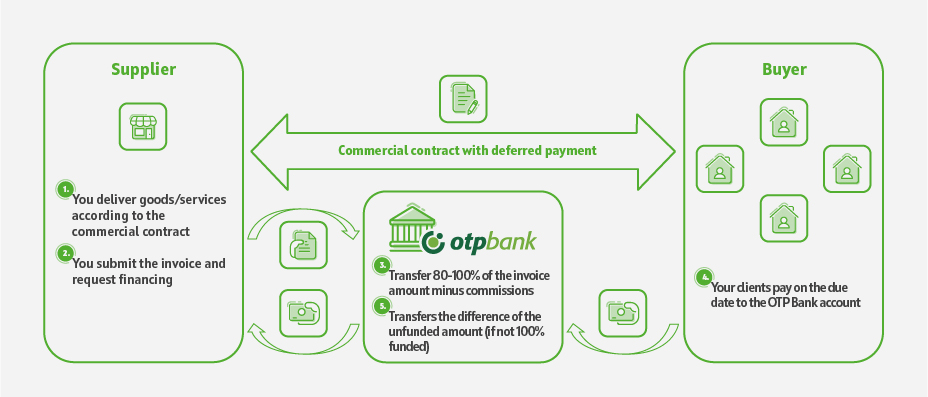
Local factoring is a financial solution that allows you to collect money for goods delivered or services provided more quickly, without waiting for payment from your customer on the due date. Basically, you assign the receivables resulting from invoices issued to domestic customers to the bank and collect payment immediately, which allows you to finance your business, grow, and strengthen relationships with partners.

Why choose Factoring from OTP Bank?

- Immediate liquidity: you receive between 80% and 100% of the invoice value in your account after the invoice is issued.
- Stable cash flow: you no longer have to wait for payment on the due date to honor your payments to suppliers or employees.
- No collateral required.
- Relationship development: you can offer your customers longer payment terms, which can improve your business relationship and create a competitive advantage.
- Digital flow through e-Factoring.

What are the conditions?

1. The business relationship is based on a commercial contract with deferred payment and regular deliveries
2. Payment term: up to 120 days
3. Invoices are not past due
4. There are no affiliate relationships with customers

Types of local factoring

  • Non-recourse: The factor assumes the risk of non-payment by the buyer. If the buyer does not pay on the due date, the factor will not request payment from the supplier (except in the case of a commercial dispute). This is only possible for buyers for whom the factor has approved a factoring limit based on an assessment of the buyer's financial standing.
  • Non-recourse: The factor assumes the risk of non-payment by the buyer. If the buyer does not pay on the due date, the factor will not request payment from the supplier (except in the case of a commercial dispute). This is only possible for buyers for whom the factor has approved a factoring limit based on an assessment of the buyer's financial standing.

How does factoring work?
FAQ

Who can be an Adherent?

A company with acceptable financial standing that delivers goods/provides services with deferred payment and wants to obtain liquidity quickly or attract new partners through flexible payment terms.

Who can be an Assigned Debtor (buyer)?

Any local company accepted by the Factor with which the supplier has a commercial relationship and to which it issues invoices with deferred payment. For non-recourse factoring, the Buyer's financial standing is essential for the bank to approve a limit.

What determines whether factoring is recourse or non-recourse?

If the bank has decided, based on an assessment of the Debtor, that it can assume the risk of non-payment by the Debtor by approving a factoring limit, it will offer non-recourse factoring; otherwise, it will offer recourse factoring based on the Supplier's financial standing.

Are overdue invoices and bad debtors accepted?

No. Factoring is based on invoices that are due but not yet collected, issued to financially stable debtors with a good payment history, and is not a debt collection service.

Is the consent of the assigned debtor required for factoring?

The assignment can be made without the debtor's consent. According to Article 1811(3) of the Civil Code of the Republic of Moldova, the assignment can be made without the debtor's consent, provided that the debtor is notified.

Will customers think my business is in trouble if they receive the factoring notification?

No. Factoring is a financial solution widely used by stable companies to optimize their cash flow. In most cases, resorting to factoring reflects a higher sales volume and the need to support this growth with quick liquidity. Factoring denotes development, professionalism, and efficient working capital management.

Is there a limit to the amount or number of invoices accepted?

No. Invoices of any amount and in unlimited numbers can be assigned, as long as they fall within the total factoring limit set out in the factoring agreement.

How quickly is payment made to the supplier?

Payment is made quickly, often on the same day that the invoices are approved and processed by the bank.

What are the costs?

In order to determine the costs of the operation, information is required on the commercial relationships for which factoring is requested. The cost is influenced by the number of commercial relationships, the quality of the proposed debtors, the turnover to be carried out through factoring, etc.

Who bears the costs?

The costs are usually borne by the supplier, but they can be negotiated and flexibly shared between the parties depending on the commercial relationship.

Need a personalised consultation?


Contact us on our phone numbers:


Send us an e-mail to: factoring@otpbank.md